1.1 What Your Audience Actually Sees
There is a moment that happens when you land on a feed or a website for the very first time. You haven't read a caption, not seen a price and you don't know the story yet. But within a few seconds, sometimes faster than that, you have already made a decision. You stay, or you scroll. You feel something, or you simply don't.
Research in visual cognition has established that people form a first impression in under 50 milliseconds. That is before reading. Before thinking. It's a feeling and then a decision before the conscious mind has had any say at all.
This is what your audience actually sees. Your intentions are invisible to them and the effort that went into the shoot is invisible. The caption you rewrote four times. They see your brand cold, without context, without your story. And the question that matters is: what do they feel?
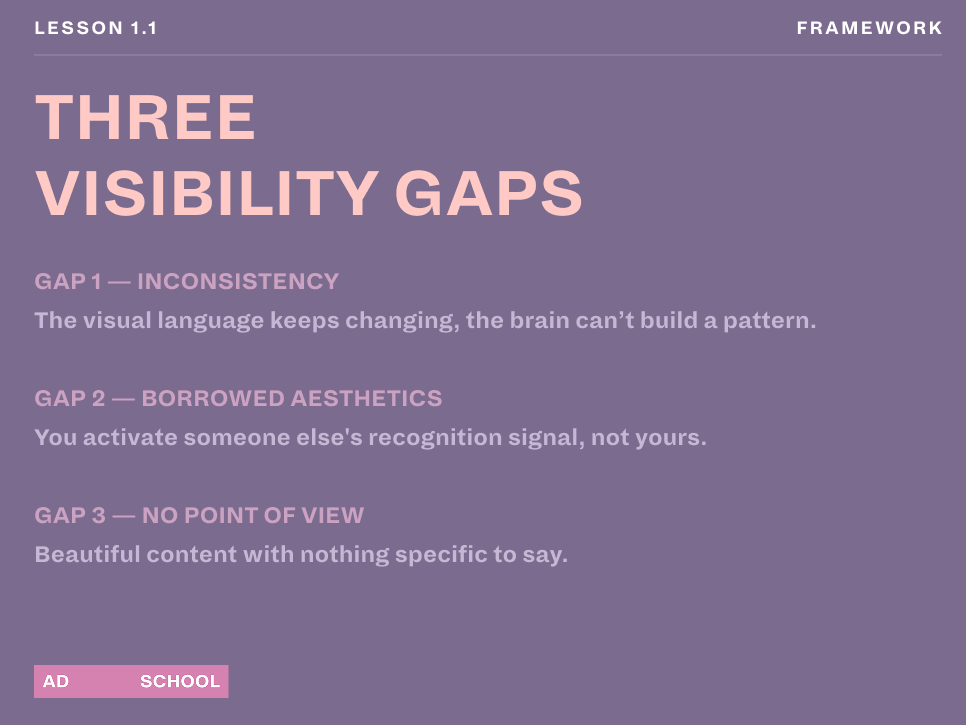
Most brands stay invisible not because they are poorly made, but because of one of three gaps [see framework]
The first is inconsistency. Our brains are pattern-recognition machines. When a brand's visual language keeps shifting: different colour temperature, different mood, different energy, the brain can't build a memory. Psychologist Robert Zajonc identified this as the mere exposure effect: repeated exposure to a consistent stimulus builds familiarity, and familiarity builds trust. The operative word is consistent. When the signal keeps changing shape, familiarity never accumulates. You start from zero every time.
The second gap is borrowed aesthetics, and I think this is the one that hurts most, because it almost always comes from a place of genuine taste. You love what another brand is doing. The warm tones, the light, the specific mood and you study it. You produce something in that direction. What you end up with is a version of their signal, which means when your audience encounters it, they feel the other brand. You have activated someone else's recognition and come out looking like a slightly lesser version of an original.
The third is no point of view. This is the hardest to name, because the images might be genuinely beautiful. The production might be excellent. But there is nothing specific at the centre. It could belong to any brand in the category. Beauty without perspective is content. It fills a feed but it does not build a world, and worlds are what produce recognition.
There are two ways to build a brand. Product-led: the product is the centre, the identity lives in the object.
And world-led: there is a clearly defined world, and the products come from it. The brand is the world. The product is how you access it.
The difference matters because of what can and can't be replicated. A product can be copied; materials, shapes, finishes can all be reverse-engineered. A world, when it is genuinely specific and deeply personal, can't. You can make the thing. You can't make the feeling it comes from.
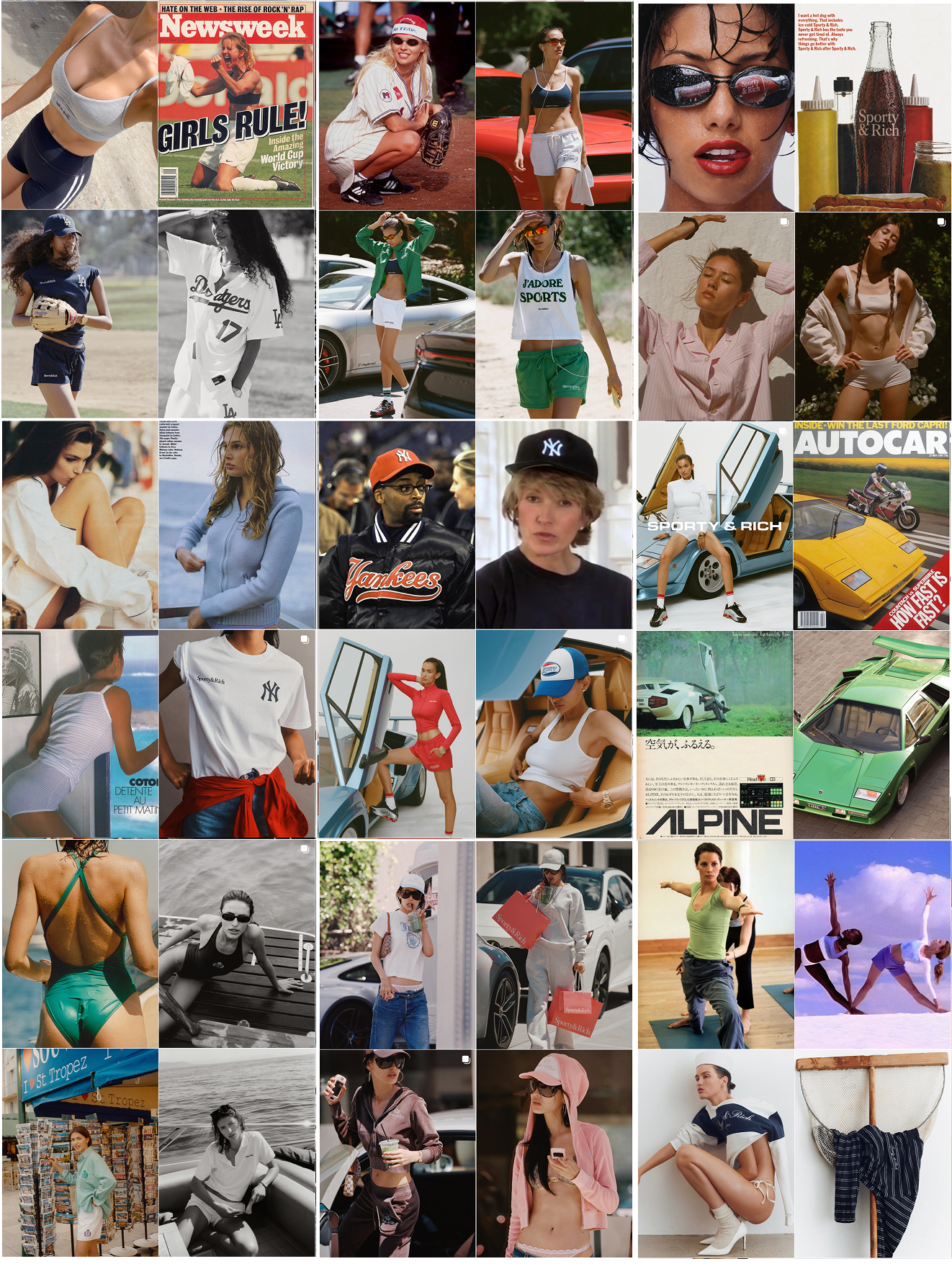
Emily Oberg built Sporty & Rich this way. The clothing actually didn't come first, she built a world first on an Instagram mood board page. A specific visual sensibility, a way of seeing, an aesthetic completely her own. When the product finds you, it feels like it came from somewhere real. That feeling is recognition. And it is what everything in this course is about building.
The next lesson goes further inward: from what your audience sees to what your brand actually is.